We have compiled a list of manufacturers, distributors, product information, reference prices, and rankings for Legal processing device.
ipros is IPROS GMS ・ IPROS One of the largest technical database sites in Japan that collects information on.

Legal processing device - List of Manufacturers, Suppliers, Companies and Products | IPROS GMS

Legal processing device Product List

1~6 item / All 6 items

Displayed results

Technical Document: "Physical Treatment [Advanced Oxidation Process (AOP)]"

A guide to water treatment technology! Featuring "Physical treatment by advanced oxidation processes."

The technical document "Physical Treatment: Advanced Oxidation Process (AOP)" is an explanatory text on water treatment technology by Japan Wacon Co., Ltd., which has been comprehensively engaged in engineering, equipment design and manufacturing, and maintenance management related to water treatment since its establishment. This document explains the physical treatment using the Advanced Oxidation Process (AOP). [Contents] ■ Principles of AOP treatment ■ Features of AOP treatment ■ AOP treatment flow sheet ■ Hydroxyl radical consumption substances For more details, please refer to the catalog or feel free to contact us.

  • Wastewater/wastewater treatment equipment
  • Water treatment equipment
  • Technical and Reference Books
  • Legal processing device

Added to bookmarks

Bookmarks list

Bookmark has been removed

Bookmarks list

You can't add any more bookmarks

By registering as a member, you can increase the number of bookmarks you can save and organize them with labels.

Free membership registration

What is the activated sludge method? Basics of its mechanism and operation [Fundamental Knowledge]

The activated sludge method cultivates a mass of microorganisms to decompose organic matter in wastewater. This explains the roles of the aeration tank and the sedimentation tank, the reasons for recycling sludge, and the key points for daily management.

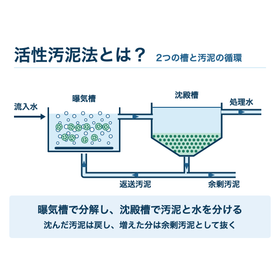
The activated sludge method is a treatment process that uses a collection of microorganisms (activated sludge) that utilize oxygen to break down organic matter in wastewater. It is a widely used representative biological treatment method, from sewage treatment plants to industrial wastewater treatment. The effectiveness of the treatment is greatly influenced by how well the activity of these microorganisms is maintained. ■ Dividing roles in two tanks 1. Aeration tank: Air is supplied to allow microorganisms to break down organic matter. 2. Sedimentation tank: The clumps of microorganisms (flocs) are settled to separate the clean supernatant. The supernatant is discharged as treated water, while the settled sludge is redirected for further processing. Whether the separation in the sedimentation tank is successful significantly affects the quality of the treated water. ■ Why circulate the sludge? The sludge that settles in the sedimentation tank is returned to the aeration tank (return activated sludge). This is to maintain a sufficient quantity of the microorganisms, which are the main agents of decomposition, within the tank. At the same time, as microorganisms multiply while breaking down organic matter, the excess is removed as surplus sludge to maintain the sludge volume in the tank. ■ Is it like adding to a bread starter? The concept of the activated sludge method is to continue operating while leaving behind active microorganisms, similar to how a portion of the previous dough is retained for the next batch of bread. Please feel free to consult with us first.

  • 023_main.png
  • 023_sub.png
  • Wastewater treatment equipment, technology and maintenance
  • Sludge treatment equipment and technology
  • Aeration equipment
  • Legal processing device

Added to bookmarks

Bookmarks list

Bookmark has been removed

Bookmarks list

You can't add any more bookmarks

By registering as a member, you can increase the number of bookmarks you can save and organize them with labels.

Free membership registration

What is the standard activated sludge method? Differences from the long-term aeration method [Basic Knowledge]

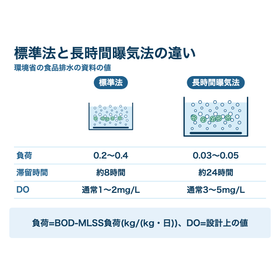
The starting point of various methods of the activated sludge process, the standard activated sludge method. We will compare what the modified methods have changed and the differences in retention time and load.

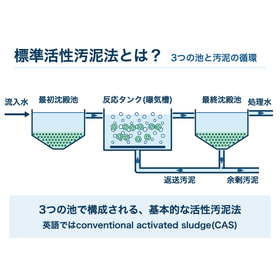
The standard activated sludge method is a basic activated sludge process consisting of an initial sedimentation tank, a reaction tank (aeration tank), and a final sedimentation tank. It is sometimes referred to simply as the "standard method." ■ Does "standard" mean a specification? There are indications that the flow of treatment alone does not fully define the standard method. In this context, some interpret "standard" as referring to the original method from which many variations have emerged. ■ The English name is CAS In English, it is commonly translated as conventional activated sludge (abbreviated as CAS), which has a connotation close to "traditional." ■ How widely is it used in wastewater treatment plants? There are over 600 installations of this method in domestic wastewater treatment plants, making it the second most common method after the oxidation ditch method. When limited to treatment plants with a capacity exceeding 10,000 cubic meters per day, the share rises to about 70%, indicating that larger treatment plants tend to choose the standard method. Additionally, creating anaerobic conditions upstream of the reaction tank is widely implemented as a measure against filamentous bulking. Please feel free to consult with us.

  • 038_main.png
  • 038_sub.png
  • Wastewater treatment equipment, technology and maintenance
  • Sludge treatment equipment and technology
  • Aeration equipment
  • Legal processing device

Added to bookmarks

Bookmarks list

Bookmark has been removed

Bookmarks list

You can't add any more bookmarks

By registering as a member, you can increase the number of bookmarks you can save and organize them with labels.

Free membership registration

回分式活性汚泥法とは?1つの槽で処理するしくみ【基礎知識】

曝気も沈殿も同じ槽で、時間を区切って行う回分式活性汚泥法。1サイクルの工程と、小規模な排水に使われる理由。

回分式活性汚泥法は、1つの槽で排水の受け入れ、曝気、沈殿、上澄みの排出を順番に行い、これを繰り返す活性汚泥法です。SBRと表記されることもあります。 ■場所ではなく時間で分ける! 連続して水を流す方式では、分解は曝気槽、固液分離は沈殿槽と、槽ごとに役割を分けます。回分式では、同じ槽の中で工程を時間で切り替えます。環境省の食品排水の資料でも、沈殿槽を設けずに曝気を止めて汚泥を静かに沈め、上澄みだけを放流する運転が紹介されています。この運転は、低い負荷で長く曝気する方式で行われることが多いとされています。日本下水道事業団による活性汚泥法の整理でも、流入のさせ方を変えた変法の一つに位置づけられています。 ■1サイクルの流れは? 同じ資料の図をもとにすると、基本の流れは次のとおりです。 1.受け入れ:排水を槽に入れる 2.曝気:空気を送り、活性汚泥に有機物を分解させる 3.沈殿:曝気を止め、汚泥を静かに沈める 4.排出:上澄みを処理水として流す 沈殿した汚泥は槽に残り、次のサイクルの処理に使われます。まずはお気軽にご相談ください。

  • Wastewater treatment equipment, technology and maintenance
  • Sludge treatment equipment and technology
  • Aeration equipment
  • Legal processing device

Added to bookmarks

Bookmarks list

Bookmark has been removed

Bookmarks list

You can't add any more bookmarks

By registering as a member, you can increase the number of bookmarks you can save and organize them with labels.

Free membership registration

Advanced Oxidation Process (AOP)

Decomposing and harmlessly treating difficult-to-decompose organic substances! We propose treatment methods tailored to the composition of wastewater.

The "Advanced Oxidation Process (AOP)" refers to a technology that actively utilizes OH radicals generated through various means such as ozone and UV to oxidatively remove organic substances contained in water. The characteristics of OH radicals (hydroxyl radicals) include high reactivity and oxidation power, allowing them to react with and treat most organic and reducing substances. It addresses difficult-to-treat, non-degradable organic substances such as dioxins and dioxane. 【Features】 - Decomposes non-degradable organic substances by combining ozone (O3) and hydrogen peroxide (H2O2). - Non-degradable organic substances are broken down into CO2 and H2O, rendering them harmless. - The use of powerful OH radicals allows for a wide range of applicability. *For more details, please refer to the related links or feel free to contact us.*

  • Wastewater/wastewater treatment equipment
  • Other water treatment equipment
  • Water treatment equipment
  • Legal processing device

Added to bookmarks

Bookmarks list

Bookmark has been removed

Bookmarks list

You can't add any more bookmarks

By registering as a member, you can increase the number of bookmarks you can save and organize them with labels.

Free membership registration